

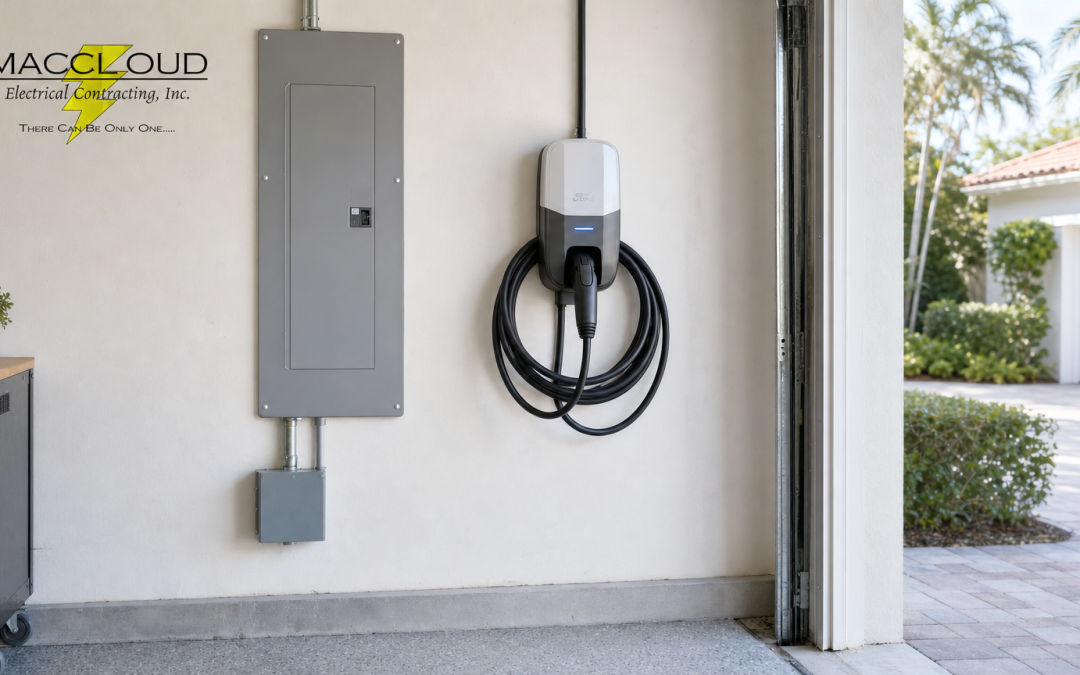
The Real Question Before You Buy a Charger
Most people start shopping for a home charging station for your EV before they know whether their house can run one. That's backwards. The charger itself is the easy part — a wall-mounted unit, a dedicated circuit, done. The question that actually determines cost, timeline, and whether you need permit work is whether your electrical panel has the spare capacity to carry a new high-draw circuit continuously, for hours, without tripping or overheating anything else on the system.
Before you compare charger brands, find out your panel's total amperage, how much of that capacity is already committed to your existing circuits (HVAC, water heater, kitchen appliances, pool equipment if you have one), and how much headroom is left. That single number shapes almost every other decision in this process.
It also helps to think of the project in three separate parts rather than one purchase: the panel's available capacity, the circuit that runs from the panel to the charger location, and the charger unit itself. Homeowners often price only the third part — the charger — and are surprised when the first two turn out to be where the real cost and complexity live. Knowing which of the three you're actually dealing with before you request quotes saves time on both ends.
Level 1 vs. Level 2: What You're Actually Choosing Between
A Level 1 charger plugs into a standard 120-volt outlet — the same type as a lamp or a phone charger. It works, but it's slow, typically adding only a few miles of range per hour. Most EV owners who charge daily find it isn't fast enough to keep up with normal driving.
A Level 2 charger runs on a 240-volt circuit, similar to an electric dryer or range. It charges several times faster and is what most homeowners mean when they say they want a 'home charging station.' It also draws significantly more continuous current, which is exactly why panel capacity matters so much more with Level 2.
As an example of how this plays out: a household that drives under 30 miles a day and charges overnight for eight or more hours might get by fine on Level 1, since there's time to recover the range used. A household that drives longer distances, has two EVs sharing one charger, or wants the car ready in a few hours rather than overnight usually needs Level 2 to make the math work. The decision isn't really about preference — it's about how much charging time you actually have available each day, matched against how much range you need back.
The 80% Rule and Why It Matters for Your Panel
Electrical code treats EV charging as a continuous load — one that runs at or near full draw for three hours or more. For continuous loads, the breaker and circuit are not allowed to be loaded past 80% of their rated capacity. In practice, that means a 40-amp charger needs a 50-amp breaker and a correctly sized circuit, not a 40-amp breaker run at its limit.
This isn't a suggestion — it's a safety margin built into the code because continuous heat buildup on an undersized circuit is a real fire risk. It's also the reason a charger that looks 'close enough' on paper to your panel's remaining capacity often isn't close enough in practice once the 80% rule is applied.
A useful way to picture it: if your panel shows 40 amps of spare capacity on a load calculation, that doesn't mean you can safely add a 40-amp continuous circuit. Applying the 80% rule in reverse, a breaker needs to be rated for at least 1.25 times the charger's continuous draw — so that same 40 amps of apparent headroom really only supports a charger drawing around 32 amps continuously, once the margin is built in. This is the kind of calculation that belongs to a licensed electrician doing a proper load calculation on your panel, not an estimate made by eye.
Does Your Panel Have Room — Or Does It Need an Upgrade First?
Older homes, or homes where other high-draw additions (a pool heater, a second HVAC system, a hot tub) have been added over the years, often find the panel is already near its limit before an EV charger is even considered. In that case, the charger itself isn't the project — a panel upgrade is, and the charger installation follows once the panel has the capacity to support it safely.
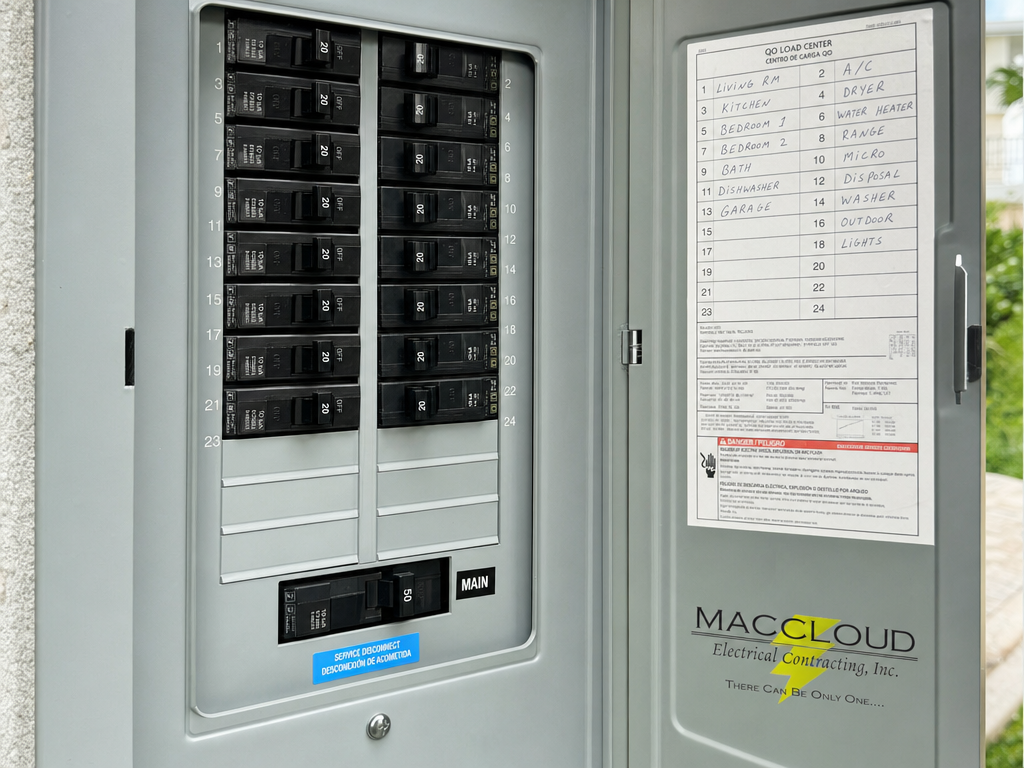
This is worth checking before you set a budget for the charger alone, since the panel work, if needed, is usually the larger line item in the overall project.
A few signs point toward a panel that's likely running close to its limit: a panel rated at 100 amps or less in a home with central air conditioning, an electric water heater, and a pool pump already running; a panel with no open breaker slots; or a home where adding one more major appliance in the past has already required rearranging circuits. None of these guarantee an upgrade is needed — only a load calculation on the actual panel will confirm that — but they're reasons to ask the question before assuming the charger alone will cover the whole project.
Permits, Inspection, and Why This Isn't a DIY or Handyman Job
Adding a dedicated 240-volt circuit for continuous high-amperage load is electrical work that falls under code requirements, not general handyman scope. Permitting and inspection exist specifically to confirm the circuit, breaker, and panel capacity are sized correctly for a continuous load — the same 80% rule above gets checked by an inspector, not just assumed by whoever runs the wire.
If you're weighing whether this is a job you can have someone other than a licensed electrician handle, it's worth understanding where that line sits — we cover it in more detail in Handyman vs Licensed Electrician for Small Jobs. EV charger circuits sit firmly on the licensed-electrician side of that line because of the continuous-load and panel-capacity requirements involved.
Skipping the permit step doesn't just create a code problem on paper. An uninspected circuit means no one has verified the breaker is correctly sized, the wire gauge matches the amperage, or the connections at the panel are torqued correctly — all things that matter specifically because the circuit will be under sustained load for hours at a time, night after night, for as long as you own the vehicle. The inspection is the point where someone other than the installer checks that work.
Where the Charger Goes (and Why Location Isn't Just Convenience)
The physical location of the charger affects the length of circuit run from the panel, which in turn affects material cost and sometimes conduit requirements if the run crosses exterior walls or is exposed to weather. Garage-mounted chargers near the panel are typically the simplest install. Driveway or carport locations further from the panel mean a longer run, and outdoor-rated equipment and conduit if the unit itself is exposed to the elements.
Florida's humidity and coastal exposure are already a factor the client's own guide to common electrical code violations in Florida homes addresses for general wiring — the same environmental considerations apply to any outdoor-mounted charging equipment, since moisture intrusion into connections or panels is a recurring issue in this climate.
Before settling on a location, it's worth walking the actual route the circuit would take from the panel to the proposed spot. A charger mounted on the opposite side of the garage from the panel, or on a detached carport, can mean running conduit through walls, under slabs, or along exterior surfaces — each of which adds labor and materials beyond the charger itself. Choosing a location close to the panel, where practical, is one of the few decisions in this project that's within the homeowner's control from the start.
What Actually Drives the Cost
Charger installation cost isn't one number — it's the sum of several variables: whether the panel has existing capacity or needs an upgrade, the length and complexity of the circuit run, whether the installation location is indoors or requires outdoor-rated conduit, permit fees, and the charger unit itself. A home with a modern panel and ample capacity, charger mounted close to the panel, is a straightforward project. A home needing a panel upgrade plus a long exterior run is a different scope entirely. Getting a firm number means having someone look at your actual panel and the planned charger location — generic cost ranges online won't reflect your specific setup.
As a practical way to prepare for that conversation, it helps to have a few things ready before you call: your panel's rated amperage (usually printed on the inside of the panel door), a rough idea of where you want the charger mounted, and whether you already own the charger unit or need a recommendation on one. None of that replaces an actual look at the panel, but it means the first conversation can focus on scope rather than starting from zero.
Does an EV Charger Add Home Value?
This comes up often, and the honest answer is that it depends on your market and buyer pool — there isn't a universal figure that applies to every home or every area. What's more reliably true is that a correctly permitted, code-compliant installation is an asset at resale, while an unpermitted or undersized circuit can become a disclosure issue or a repair cost for the next owner. If resale value is part of your decision, permitted work done to code is the part that protects it.
It's also worth separating two different questions that tend to get merged: whether an EV charger makes a home more attractive to a buyer who already owns an EV, and whether it adds measurable resale value to any buyer. The first depends entirely on who ends up looking at the home when it's listed. The second is harder to generalize, and nothing in this guide should be read as a promise either way. The one part within your control is making sure the work, if you do it, is documented and inspected — that's the detail a buyer's inspector or appraiser can actually verify.
Questions and answers
What is the 80% rule for EV charging circuits?
Because EV charging counts as a continuous load, code requires the breaker and circuit to be sized so the charger's draw never exceeds 80% of their rated capacity. A charger pulling 40 amps continuously needs at least a 50-amp breaker and matching wiring, not a breaker sized to its exact draw.
What factors should I consider when choosing a home EV charger?
Start with your panel's available capacity, since that determines whether Level 2 charging is possible without a panel upgrade. Then factor in the charger's physical location, the length of the circuit run, whether the install is indoors or exposed to weather, and whether a permit and inspection are required for the work.
Does having an EV charging station increase home value?
There's no fixed figure for this, and it varies by market and buyer. What matters more consistently is that the installation is permitted and code-compliant — that protects value, while unpermitted or undersized work can become a liability at resale.
If you're not sure whether your panel has the capacity for a Level 2 charger, contact MacCloud Electric to have your panel and circuit options reviewed before you buy equipment.