

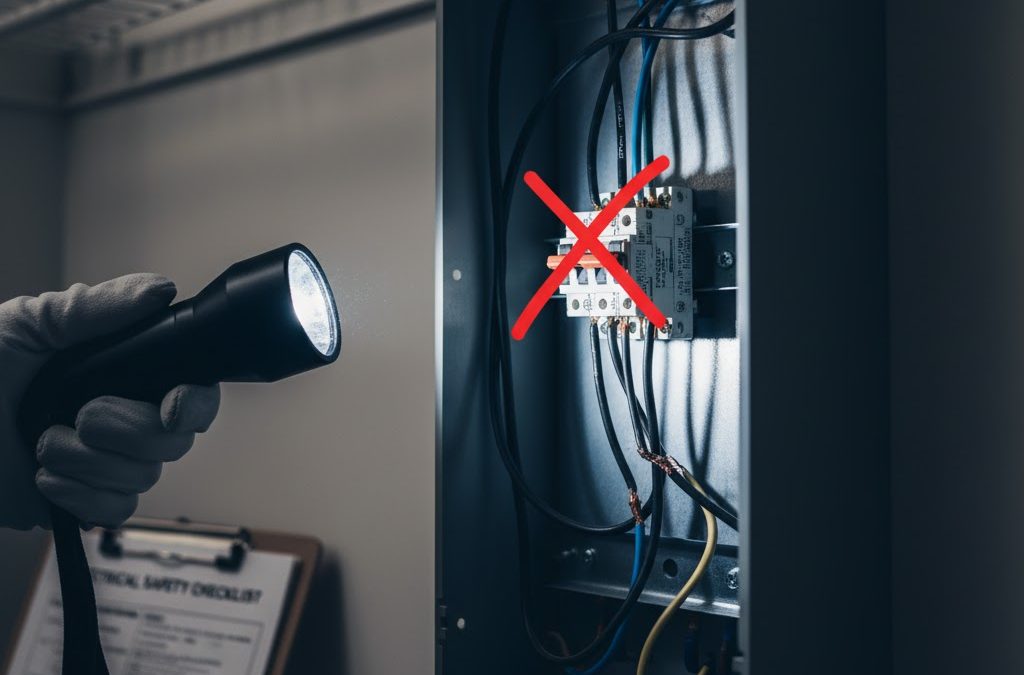
If you’re buying, selling, or simply updating a home in Palm Beach County, the state of your electrical system is not just a matter of convenience—it’s a critical safety and financial issue.
For homeowners in communities from Jupiter to Boca Raton, adhering to the latest electrical code is non-negotiable. Whether you’re preparing for a four-point insurance inspection or bracing for a buyer’s home inspection, a handful of common, often hidden, electrical code violations can instantly become a costly hurdle that delays closing, cancels an insurance policy, or requires expensive, last-minute repairs.
We are MacCloud Electric, your licensed and insured electricians serving the Palm Beach area. We routinely get called in to fix these exact issues—from the expensive to the dangerous—that cause panic and delays. Don’t wait for the inspection report. Be proactive with this essential guide.
🛑 STOP: Get Your Palm Beach Electrical Safety Inspection Checklist
Before an inspector arrives or you finalize a sale, use this checklist to proactively assess your home’s electrical risk factors. This is a condensed look at the major issues that fail inspections across Palm Beach County. If you check YES to any of these, you need to call a licensed professional immediately.
| Assessment Area | Yes | No | Why it Matters (Risk Factor) |
| Panel Age/Type: Is your main electrical panel older than 25 years (e.g., Federal Pacific, Zinsco, or Challenger)? | High risk of internal failure and fire, often requires immediate replacement for insurance. | ||
| DIY/Handyman Work: Was any significant wiring, light, or outlet installed without a permit or a licensed electrician? | Assumed to be non-compliant, unsafe, and creates homeowner liability. | ||
| Missing Protection: Are regular outlets present near water (kitchen/bath/garage) instead of GFCI outlets? | High electrocution risk; a major life-safety code violation. | ||
| Exposed Wiring: Do you have any open junction boxes or visible, uncapped wires in the attic or crawlspace? | Immediate fire and shock hazard. | ||
| Overloaded Circuits: Do lights frequently flicker, or do you trip breakers when using multiple appliances? | Indicates circuit stress, which can lead to overheating and fire in the walls. | ||
| Aluminum Wiring: Do you have original aluminum branch circuit wiring (common in 1960s-1970s homes)? | Known fire hazard due to expansion/contraction at connection points. | ||
| Smoke/CO Detectors: Are your smoke alarms older than 10 years, or are they not hardwired in bedrooms? | Modern code requires hardwired, interconnected alarms for safety. |
⚠️ DON’T RISK YOUR CLOSING DATE! Your home’s electrical system must comply with the strict Palm Beach County electrical codes and insurance mandates. If you answered “Yes” to any point above, call MacCloud Electric for a detailed Pre-Sale Electrical Safety Inspection and Code Correction Plan. We handle the paperwork, the permits, and the professional correction.
Call MacCloud Electric at (561) 722-3874
Understanding the Importance of Code in Palm Beach County
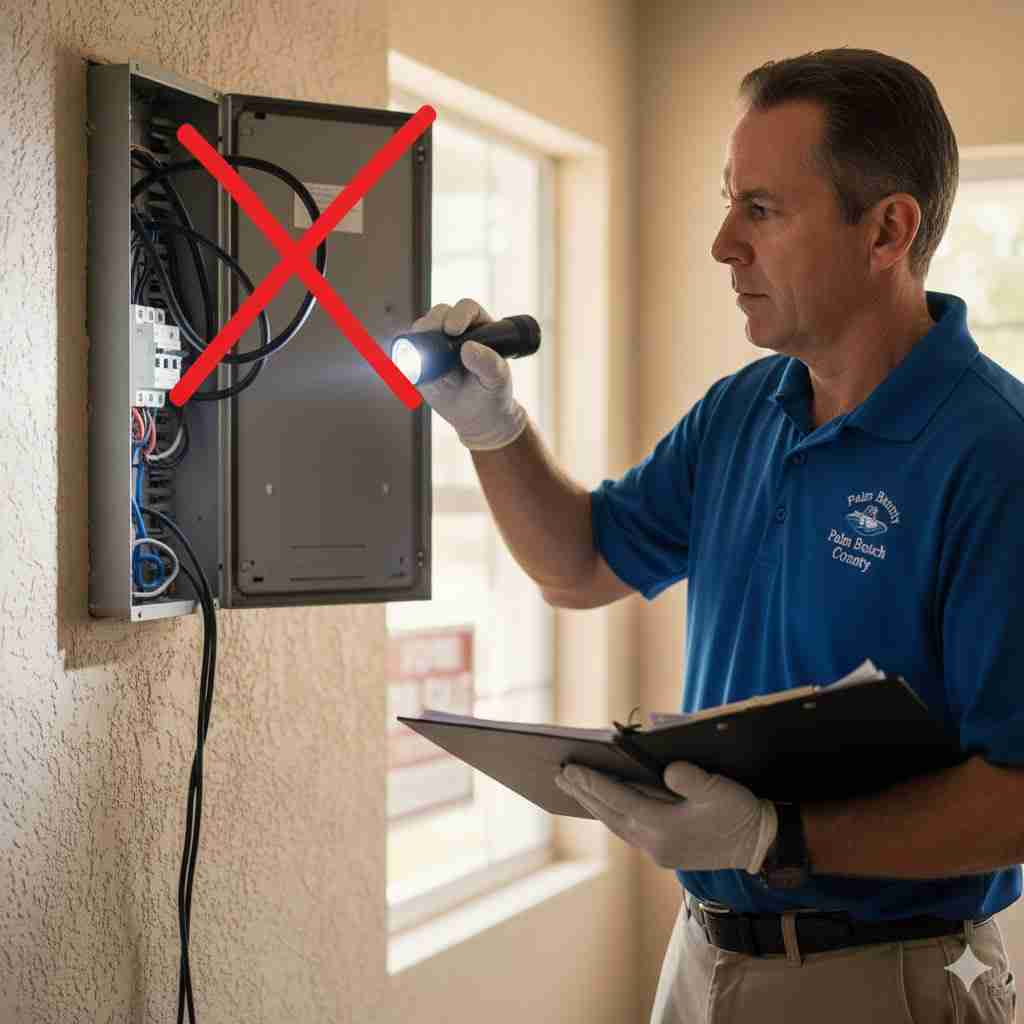
Florida has adopted the National Electrical Code (NEC) as its statewide standard, but local municipalities like those in Palm Beach County often add amendments and have their own stringent inspection processes. This is especially true for coastal properties, which face additional environmental factors like corrosion and high humidity.
When an inspector comes through, they are not just looking at functionality—they are verifying that the system was installed according to the code version in effect at the time of construction, and more critically, that it does not contain any code violations that represent a modern safety risk.
The 5 Code Violations That Will Fail Your Inspection
These five issues are the most common and critical failures that we see MacCloud Electric technicians correcting for frantic homeowners every week.
1. The Outdated or Overloaded Electrical Panel (The Heart of the Problem)
Your electrical panel, or breaker box, is the heart of your home’s electrical safety. Unfortunately, many homes built before the late 1980s still operate on panels that are considered hazardous or simply insufficient for modern electrical demands.
The most notorious inspection failures involve two specific panel brands: Federal Pacific Electric (FPE) Stab-Lok and Zinsco panels.
- FPE Stab-Lok: These panels have a documented history of breaker failure. When overloaded, the breaker often fails to trip, causing the wire insulation to melt and leading to fire. Insurance companies and inspectors flag these immediately.
- Zinsco: These aluminum-bus panels can have poor internal contact, leading to overheating, melting, and eventual electrical failure without ever tripping the main breaker.
Beyond brand failures, inspectors look for double-tapped breakers. A double-tap occurs when two wires are incorrectly connected under a single screw terminal in the panel. This overloads the breaker, causes overheating, and is an immediate, zero-tolerance code violation that requires professional correction.
Why it Fails Inspection: The National Electrical Code (NEC) mandates that panels must be listed, properly installed, and capable of safely handling the home’s load. An old, overloaded, or incorrectly wired panel is a severe fire hazard.
The Solution and Value Proposition: If your home is 25 years or older, this is your biggest financial risk. Upgrading to a modern 200-amp service not only eliminates the fire risk but provides the capacity for modern Palm Beach living—think charging stations for electric vehicles (EVs), running high-efficiency HVAC systems, and powering new pool equipment. This added capacity is a major selling point for buyers.
2. Missing or Improper GFCI and AFCI Protection
The code around ground-fault circuit interrupters (GFCI) and arc-fault circuit interrupters (AFCI) is constantly changing. Inspectors know that updated code requires a higher level of protection in specific areas of the home to prevent electrocution and fire.
- GFCI outlets protect people from severe electrical shocks by sensing a difference in current (a “leak”) and shutting off rapidly. They are now required in all wet or damp locations: bathrooms, kitchens, garages, unfinished basements, and all outdoor receptacles.
- AFCI breakers protect against electrical fires by detecting dangerous electrical arcs in wiring. They are typically required in living rooms, dining rooms, bedrooms, hallways, and similar areas.
Many homes built even 10-15 years ago are not compliant with the latest NEC edition adopted by Florida. If your home’s kitchen counter or bathroom outlets are not GFCI-protected, or if your bedroom circuits lack AFCI protection, your inspection will fail. This is especially true for 4-point insurance inspections, which specifically look for these updated safety devices.
Why it Fails Inspection: This is a direct life-safety issue and a non-negotiable requirement of modern code designed to prevent the majority of home electrical fires and electrocutions.
The Solution and Value Proposition: GFCI/AFCI issues are simple fixes but critical for passing inspection. MacCloud Electric can perform a targeted code correction service using state-of-the-art GFCI/AFCI breakers or outlets, bringing these areas up to the most recent code with minimal disruption.
3. Unpermitted, DIY, or Handyman Wiring (The Liability Trap)
This violation is a product of homeowner convenience and misunderstanding. Homeowners hire an unlicensed handyman electrician or perform the work themselves (DIY) to save a few dollars on projects like installing a new outlet, running a line to an irrigation system, or adding recessed lighting.
The problem is twofold: legality and safety.
- Legality: Most electrical work legally requires a permit, and only a licensed electrical contractor can pull that permit in Palm Beach County and have the work officially inspected by the city or county.
- Safety: Unlicensed individuals often lack the training to understand the NEC’s complex load calculations, grounding requirements, and proper wire sizing, leading to systems that are unsafe even if they appear functional.
Why it Fails Inspection: If an inspector discovers work that was clearly done without a permit—such as a new subpanel, a dedicated circuit for a pool heater, or new recessed lighting—it immediately raises a red flag. Unpermitted work is assumed to be non-compliant, unsafe, and will require you to pay a licensed contractor to tear out the work, re-do it correctly, and pull the required permits, essentially paying twice.
This is the ultimate liability trap. If unpermitted work causes a fire or injury, your home insurance may deny the claim because the work was not performed to code or by a qualified professional.
The Solution and Value Proposition: If you suspect a previous DIY job or handyman electrical work, MacCloud Electric can perform a Legal Compliance Audit. We are experts in dealing with the Palm Beach County building department. We know the necessary procedures to legalize and verify the safety of existing work, ensuring you avoid the headache and cost of a denied insurance claim or a delayed closing.
4. Exposed Wiring and Improper Junction Boxes
While the first three points are about internal mechanics and protection, this violation is about basic physical safety.
Electrical splices and connections must always be contained within a junction box that is approved, covered, and readily accessible. This is a non-negotiable rule designed to prevent fire and shock hazards.
Why it Fails Inspection: Inspectors frequently find violations in the attic, crawl spaces, or unfinished areas:
- Wires spliced together and wrapped in electrical tape (a serious fire hazard).
- Junction boxes covered or buried behind drywall, insulation, or ceiling material (making them inaccessible for inspection and future repair).
- Junction boxes missing their protective covers.
Any exposed wire is an immediate code failure. Any inaccessible splice is also a failure. This issue is especially common during renovations or after old light fixtures are replaced, where workers assume a box can be safely hidden.
The Solution and Value Proposition: MacCloud Electric ensures every splice, connection, and junction box is code-compliant, fire-rated, and properly installed. We can quickly trace and correct these issues, ensuring fire safety and compliance. We recommend homeowners perform a quick visual inspection of the garage, attic, and basement for any signs of exposed wire before we arrive.
5. Improper Grounding and Bonding
In a coastal environment like Florida, proper grounding and bonding is essential for safety, especially around water sources like swimming pools, docks, and irrigation systems.
- Grounding provides a safe path for fault current to escape to the earth in the event of a short circuit.
- Bonding ensures that all metal parts of the electrical system and structural metal are electrically connected, preventing dangerous voltage differences between objects.
Without proper grounding and bonding, a fault could electrify metal fixtures or appliances, posing a deadly shock risk. This is not a common DIY fix; it requires specialized knowledge of the electrical system and the surrounding environment.
Why it Fails Inspection: Inspectors check the main service entrance, the panel, and large equipment (A/C units, pools). If they find a missing or corroded grounding electrode conductor, or if metal piping and appliances are not properly bonded, they will red-flag it as a serious safety hazard. The high salt content and moisture in the Palm Beach environment accelerate corrosion, making this a frequent failure point in older homes.
The Solution and Value Proposition: Our licensed technicians perform a full system assessment to verify grounding and bonding integrity. We correct corroded grounding rods and ensure all metal is properly bonded according to the latest Palm Beach County code amendments, protecting your appliances and, most importantly, your family from shock hazards.
What to Do When Your Palm Beach Home is Out of Compliance
Finding a code violation is not the end of the world, but it is a demand for immediate action. The worst decision you can make is trying to fix it yourself or hiring an unlicensed handyman electrician to cover it up—this only compounds the liability.
When you call MacCloud Electric, we follow a simple, compliant process:
- The Inspection: We perform a comprehensive, non-biased Electrical Safety Inspection using the same criteria as the local building department.
- The Report: You receive a detailed report outlining every violation, prioritized by safety risk and cost estimate for correction.
- The Correction: We handle all necessary permit pulling and remedial work, ensuring it is performed by a licensed professional and will pass final inspection.
We turn a code violation headache into a smooth, permitted solution. This protects you for the sale, your insurance policy, and your peace of mind.
📞 MacCloud Electric: Your Palm Beach Electrical Safety Solution
The last thing any homeowner wants is to face thousands of dollars in unexpected repair costs, a denied insurance claim, or a deal that falls apart because of a faulty electrical system.
At MacCloud Electric, we eliminate the guesswork and the risk. We believe that peace of mind should come standard with your electrical system. We work routinely with Palm Beach County building departments, HOAs, and insurance companies. We know exactly what they look for and how to ensure your system is safe, sound, and fully compliant with the latest codes.
Don’t wait for an inspector to tell you your home is unsafe or non-compliant. Be proactive. Have it checked by the trusted professionals who correct these issues every day.
FINAL CALL TO ACTION (CTA): HIGH CONVERSION
Protect Your Investment and Your Family. Schedule your comprehensive Palm Beach Electrical Safety Inspection Checklist service with MacCloud Electric today. We get you ready for the sale, the insurance policy, and a worry-free future.
[Click to Call MacCloud Electric at (561) 722-3874] | Book Now