

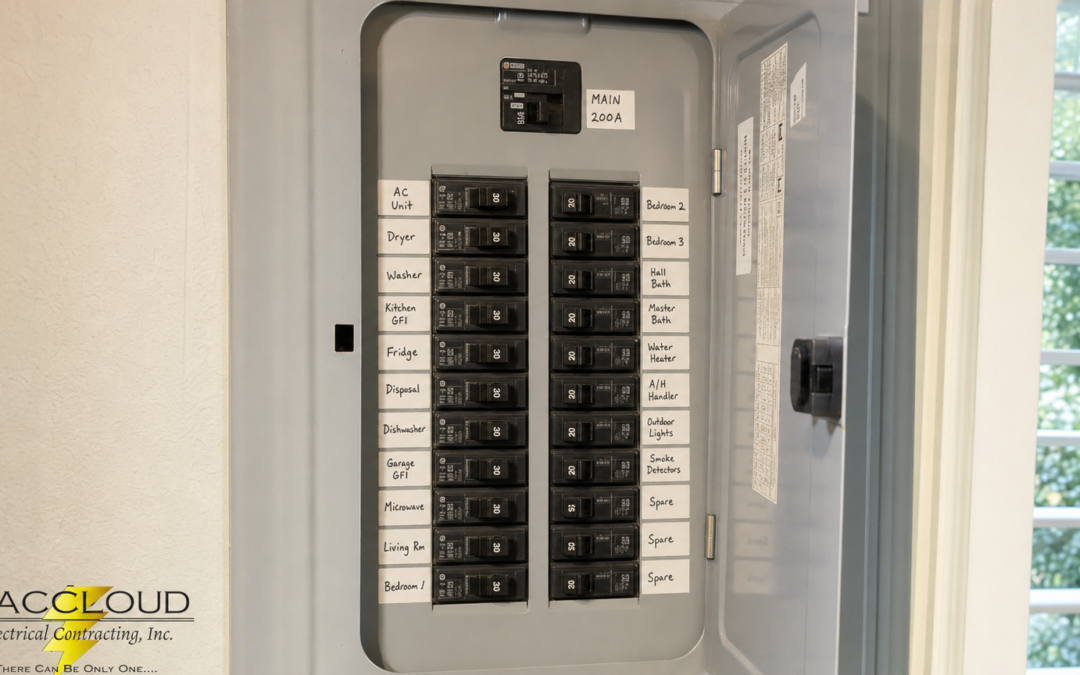
What the 80% Rule Actually Means
The 80% rule for electrical panels means a standard breaker, and the circuit it protects, shouldn't be loaded past 80% of its rating when the load runs continuously for three hours or more. A 20-amp breaker, for example, is meant to carry no more than 16 continuous amps unless the breaker is specifically rated for 100% continuous duty, in which case it can be loaded closer to its full rating.
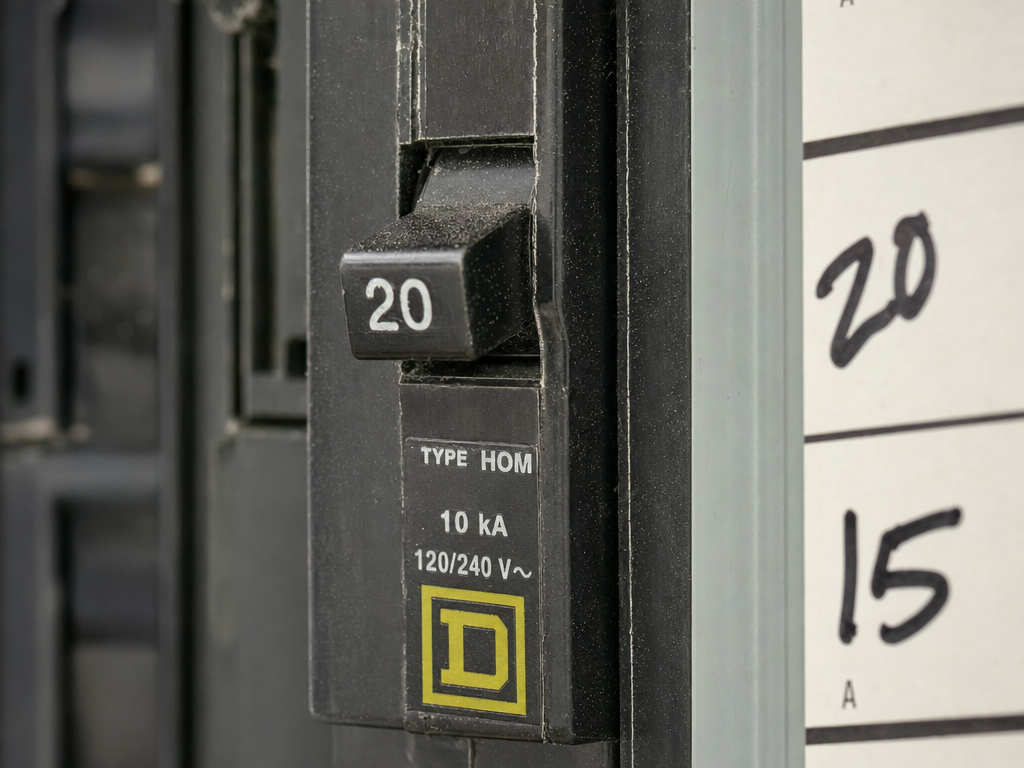
This isn't a suggestion or a rule of thumb someone made up. It comes from the National Electrical Code's treatment of continuous loads — anything that runs steadily for three hours or more, like lighting banks, HVAC compressors, or certain commercial equipment. The code treats continuous loads differently from loads that cycle on and off, because sustained current generates more heat in the wiring and breaker over time.
To put the math in concrete terms: a 30-amp breaker on a standard 80% rating tops out at 24 continuous amps, not 30. A 50-amp breaker tops out at 40 continuous amps. Those numbers matter when someone is sizing a circuit for a specific piece of equipment — a pool pump, a long run of continuous lighting, a commercial walk-in cooler compressor — because the equipment's rated draw has to fit inside that 80% ceiling, not the breaker's full label.
Why the Margin Exists
Breakers and panels are rated for a maximum current, but that rating assumes some breathing room for heat. A breaker doesn't fail the instant it hits its labeled amperage — it fails (or should trip) when sustained heat buildup becomes a fire risk. Standard breakers are tested and listed on the assumption that continuous loads will be held to 80% of the rating, leaving margin for that heat.
Think of it the way you'd think about towing capacity on a vehicle. A truck rated to tow 10,000 pounds can technically move that weight, but doing it for hours at a time, up an incline, in heat, is a different stress test than a short pull. A breaker carrying its full rated current for a brief spike handles that fine. The same breaker carrying that same current for three, six, or ten hours straight is a different thermal situation, and the 80% margin is what keeps that steady-state heat within a safe range.
This is also why panel sizing matters more than most homeowners expect. A panel that's technically rated for a home's peak draw on paper can still be undersized in practice if several circuits are running continuous loads at the same time — which is common in South Florida, where air conditioning runs for long stretches rather than short bursts. A panel that looked adequate on a spec sheet can still leave very little real-world margin once the AC, pool equipment, and a few other steady loads are running together.
80% Rated vs. 100% Rated Breakers
Most residential breakers sold are 80%-rated, meaning they're designed to be loaded to no more than 80% of their amperage for continuous use. 100%-rated breakers exist for situations where a continuous load needs to run closer to the breaker's full capacity — they're built with better heat dissipation and are more common in commercial and industrial panels than in a typical house.
The practical difference for a reader: if a load is going to run for three hours or longer at a steady draw, the breaker and panel need to be sized with that 80% ceiling in mind, not just the appliance's rated amperage. In a home, this usually means a circuit gets oversized relative to the appliance it serves — a 20-amp breaker for a load that only draws 15 or 16 amps continuously, rather than cutting it close. In a commercial setting where space and equipment costs make that kind of oversizing less practical, a 100%-rated breaker can sometimes be the better fit, since it's designed to run closer to its label without the same derating. That's a decision that depends on the specific equipment and panel, not a default choice either way.
Where the "83% Rule" Confusion Comes From
Some searches turn up a reference to an "83% rule," which isn't a separate code provision — it's the inverse of the 80% calculation. If a continuous load can only use 80% of a breaker's rating, then working backward, the breaker needs to be rated at roughly 125% of the actual continuous load (1 ÷ 0.8 = 1.25, which rounds to about 83% when expressed the other way). It's the same math looked at from two directions: load to breaker, or breaker to load. There's no additional rule beyond the 80% continuous-load principle.
As an example of the two directions: if an electrician already has a 20-amp breaker installed and wants to know the maximum continuous load it can safely carry, that's the 80% direction — 16 amps. If the same electrician is starting from a known continuous load of 16 amps and needs to pick a breaker size to serve it, that's the 125% (or ~83%) direction — which points back to a 20-amp breaker. Both calculations land on the same pairing; they're just asked in reverse order.
Does the 80% Rule Limit How Many Outlets Are on a Circuit?
Not directly. The 80% rule is about sustained current on a breaker, not the number of outlets wired to it. How many outlets can safely share a circuit depends more on the combined load those outlets are expected to carry at once, the wire gauge, and the breaker size — not a fixed outlet count. A circuit with ten lightly used outlets can be fine; a circuit with two outlets both running high-draw equipment continuously can be the one that actually trips. This is a separate question from the 80% rule, even though the two get confused in search results.
As an example: a home office circuit with a lamp, a phone charger, and a printer plugged into three different outlets draws very little continuous current even with all three in use. A kitchen circuit with a single outlet running a space heater for hours is a different story entirely, even though it's only one outlet instead of three. The outlet count tells you almost nothing on its own — the combined, sustained draw on that circuit is what the 80% math actually applies to.
What This Means for Older Palm Beach County Homes
In practice, this rule matters most when a panel is already working close to its limits. Homes with original, smaller panels — a situation we see often in older Palm Beach County neighborhoods — may have little to no margin left once HVAC and other continuous loads are accounted for, even before anything is technically "overloaded" on paper. If a panel is already borderline, the 80% continuous-load math is one more reason it may need attention.
For a homeowner trying to gauge whether this applies to their house, a few practical checks help: how old is the panel relative to when the HVAC system was last replaced or upsized, has anything been added to the electrical load since the panel was installed — a pool, a larger AC unit, an EV charger, additional living space — and does the panel's labeling still match what's actually installed on each circuit. None of those checks require opening the panel yourself; they're the kind of questions worth having answered before assuming a panel still has the margin it did when it was first put in. Our guide on common electrical code violations in Florida homes covers the panel age and capacity issues we run into most often in this area.
Why This Matters More in Commercial Spaces
Continuous loads are the rule rather than the exception in commercial buildings — lighting runs for full shifts, HVAC runs long cycles, and equipment loads can be steady for hours at a time. That makes the 80% rule a core part of how a commercial electrical system gets sized from the start, not an afterthought.
In a build-out, this shows up well before any equipment is turned on. Load calculations for a new restaurant kitchen, a retail space with extensive lighting, or a facility running production equipment all need to account for which loads are continuous and which aren't, because that distinction changes how panels, feeders, and breakers get sized on paper. Getting that wrong at the design stage is a much more expensive problem to fix once walls are closed up than it is to plan for correctly up front. If you're planning a build-out and want to understand how load calculations factor into the budget, our breakdown of commercial electrical build-out costs walks through how electrical capacity and continuous-load planning show up in a project estimate.
Signs Your Panel May Be Running Too Close to the Limit
A panel doesn't usually announce that it's near its ceiling. Breakers that trip under predictable, repeated conditions — the same circuit, the same time of day, the same appliance running — are often a sign that a continuous load is pushing past what the breaker is rated to carry safely.
Warm panel covers, a breaker that feels loose or doesn't reset cleanly, or a panel that's already full of double-tapped breakers are also worth having checked, especially if HVAC or another steady load was added after the panel was originally installed. A panel that was sized correctly for a home or space years ago doesn't automatically stay that way — additions like a second AC unit, a hot tub, or added equipment in a commercial space all shift the continuous-load math without anyone necessarily re-checking the panel against the new total. If a panel is showing any of these signs, that's a reasonable point to have someone look at actual loads against actual breaker ratings, rather than waiting for something to fail outright.
Questions and answers
What is the NEC 80% rule?
It's the code principle that a standard breaker shouldn't be loaded past 80% of its rating for continuous loads — those running three hours or more at a steady draw — because sustained current generates more heat than intermittent use.
What is the difference between an 80% and 100% rated breaker?
An 80%-rated breaker, the standard type in most homes, is meant to carry no more than 80% of its labeled amperage under continuous load. A 100%-rated breaker is built to handle continuous loads closer to its full rating and is more common in commercial and industrial panels.
What is the 83% rule in the NEC?
It isn't a separate rule — it's the same 80% continuous-load calculation worked backward, used when sizing a breaker to a known continuous load rather than checking a load against an existing breaker.
How many outlets can you run off the same breaker?
There's no fixed outlet count. What matters is the combined, sustained load those outlets draw at once relative to the breaker's 80% continuous-load capacity — a circuit with several low-draw outlets can be fine, while a circuit with one high-draw, continuously running device can be the one that trips.
If you're not sure whether your panel has room for the loads you're running, contact MacCloud Electric to have it checked.